![English [GB]](../../../language/en_GB/en_GB.jpg "English [GB]")
![Deutsch [DE]](../../../language/de_DE/de_DE.jpg "Deutsch [DE]")
![English [US]](../../../language/en_US/en_US.jpg "English [US]")
![Nederlands [NL]](../../../language/nl_NL/nl_NL.jpg "Nederlands [NL]")
)
)
)
)
)
)
)
)
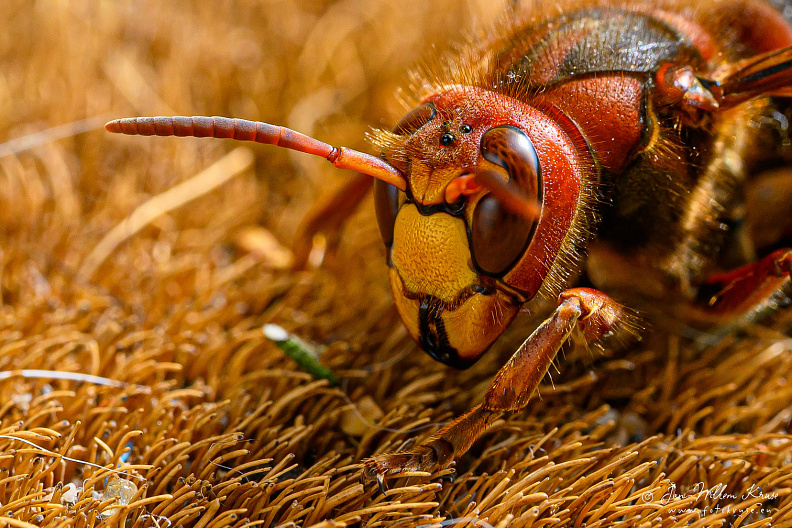
Europese hoornaar of paardenwesp (Vespa crabro)
Camera brand and type used to take photo
 NIKON Z 9
Lens used
NIKON Z 9
Lens used
 NIKKOR Z MC 105mm f/2.8 VR S @ 105 mm
NIKON Z 9
Lens used
NIKKOR Z MC 105mm f/2.8 VR S @ 105 mm
Aperture used
 f/8.0
Exposure used
f/8.0
Exposure used
 1/250 s
Exposure compensation applied
1/250 s
Exposure compensation applied
 0.0 EV
ISO used
0.0 EV
ISO used
 180
180
f/8.0
Exposure used
1/250 s
Exposure compensation applied
0.0 EV
ISO used
180
Copyright © 2022 Jan-Willem Kruse (www.fotokruse.eu).
All rights reserved. For consideration only, no reproduction without prior permission.
All rights reserved. For consideration only, no reproduction without prior permission.
Photo Info
FGK-20220526-Z9-4724-european hornet-macro-insect.jpg
2500*1667
(3483 KB)
921x visited
Description
Headline
Europese hoornaar of paardenwesp (Vespa crabro)
Caption
EN: The European hornet (Vespa crabro) is the largest eusocial wasp native to Europe. It is also the only true hornet (genus Vespa) found in North America, having been introduced by European settlers in the 1800s.[1][2] V. crabro is usually regarded as a pest by those humans who come into contact with it. Vespines, such as V. crabro, are known for making intricate paper-like nests out of surrounding plant materials and other fibers.[3] Unlike most other vespines, reproductive suppression involves worker policing instead of queen pheromone control, as was previously thought.
This species stings in response to being stepped on or grabbed, but generally avoids conflict. It is also defensive of its nest and can be aggressive around food sources. Care should be taken when they are found in these circumstances, as they may sting without warning. European hornets are largely carnivorous and hunt large insects such as beetles, wasps, large moths, dragonflies, and mantises. They also feed on fallen fruit and other sources of sugary food.
NL: De Europese hoornaar kan tot 3,5 centimeter lang worden en is hiermee de grootste wespachtige van België en Nederland. De soort komt er niet in grote aantallen voor, maar is, behalve in de kuststreek en Friesland en Groningen, niet heel zeldzaam. De hoornaar wordt meer dan twee keer zo groot als de meeste andere wespen zoals die uit het geslacht Vespula. Ondanks de lichaamsgrootte en het luide gezoem is de hoornaar niet agressief behalve als men te dicht bij het nest komt of het nest verstoort.
De steek van de Europese hoornaar is pijnlijker dan de steek van een honingbij, maar het gif is minder krachtig. Hoornaars gebruiken het gif om insecten te doden die zij vervolgens met de kaken vermalen tot een papje en aan de larven voeren. De larven geven op hun beurt een zoete vloeistof af aan de werksters die de suikers gebruiken als brandstof om te kunnen vliegen en zo nog meer insecten te vangen.
Het nest wordt gemaakt van cellulosevezels die van bomen worden geknaagd. Het nest is bolvormig en bestaat uit meerdere raten. Anders dan bij de ver verwante honingbij het geval is, is in het nest van de hoornaar geen honing aanwezig.
This species stings in response to being stepped on or grabbed, but generally avoids conflict. It is also defensive of its nest and can be aggressive around food sources. Care should be taken when they are found in these circumstances, as they may sting without warning. European hornets are largely carnivorous and hunt large insects such as beetles, wasps, large moths, dragonflies, and mantises. They also feed on fallen fruit and other sources of sugary food.
NL: De Europese hoornaar kan tot 3,5 centimeter lang worden en is hiermee de grootste wespachtige van België en Nederland. De soort komt er niet in grote aantallen voor, maar is, behalve in de kuststreek en Friesland en Groningen, niet heel zeldzaam. De hoornaar wordt meer dan twee keer zo groot als de meeste andere wespen zoals die uit het geslacht Vespula. Ondanks de lichaamsgrootte en het luide gezoem is de hoornaar niet agressief behalve als men te dicht bij het nest komt of het nest verstoort.
De steek van de Europese hoornaar is pijnlijker dan de steek van een honingbij, maar het gif is minder krachtig. Hoornaars gebruiken het gif om insecten te doden die zij vervolgens met de kaken vermalen tot een papje en aan de larven voeren. De larven geven op hun beurt een zoete vloeistof af aan de werksters die de suikers gebruiken als brandstof om te kunnen vliegen en zo nog meer insecten te vangen.
Het nest wordt gemaakt van cellulosevezels die van bomen worden geknaagd. Het nest is bolvormig en bestaat uit meerdere raten. Anders dan bij de ver verwante honingbij het geval is, is in het nest van de hoornaar geen honing aanwezig.
Image Alt text
-
Event
-
Keywords
Capture info
(IPTC Instructions)
(IPTC Instructions)
Macro of an European hornet (Vespa crabro)
Location
Location
- - - -
Altitude
-
Properties
Original filename
Z9-4724.DNG
Taken on
26-May-2022 10:52:43
Digital Source
Digital camera
Posted first on
02-Jan-2026 20:34:44
Update posted on
02-Jan-2026 20:34:48
Rating/label
Adobe Lightroom
Adobe Lightroom
Label and rating as set in Adobe Lightroom
*****
Rating score
no rating
Update rating
Rate this photo
Copyright
Credit line
Copyright © 2022 Jan-Willem Kruse (www.fotokruse.eu)
Copyright
-
Copyright Notice
-
Photographer
Jan-Willem Kruse
Other Info
Related albums
Job identifier
-
0 comments